

2026
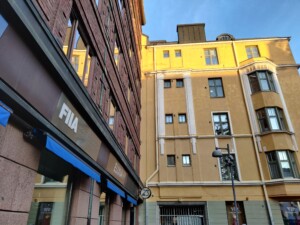
The Finnish Institute of International Affairs (FIIA) is an independent research institute that operates in connection with the Parliament of Finland. Its work centres on Finland’s foreign policy, international politics, global economic relations and the European Union.
2025
In March 2025, the Institute announced that it would discontinue Ulkopolitiikka magazine (The Finnish Journal of Foreign Affairs), which was founded in 1961.
In November, the Institute stated that it was planning to move into the premises of the Parliament of Finland in 2027.
2024
In 2024, during Director Mika Aaltola’s leave of absence, Mikael Mattlin led the Institute as his deputy. In autumn 2024, Hiski Haukkala was appointed the Institute’s current Director.
2022
In 2022, the Institute established a new security conference, the Helsinki Security Forum. The conference was held for the first time in September 2022 at the Clarion Hotel in Helsinki. Today it brings together 0ver 350 decision-makers, experts in international security and defence, and representatives of the media to discuss global security issues.

2021
In June 2021, FIIA celebrated its 60th anniversary amid COVID-19 restrictions. In an online broadcast from Bio Rex, participants discussed Finland’s role and future in a changing world.
2019
In 2019, Mika Aaltola was appointed Director of FIIA.
2015
In March 2015, the Institute organised a seminar on Europe’s security situation and Ukraine. The speaker at the event was Angela Merkel, the German Chancellor at the time.
2011
FIIA’s 50th anniversary was celebrated in September 2011 at Finlandia Hall. Speakers at the anniversary seminar included the Institute’s former Directors from different decades.
2010
In 2010, Teija Tiilikainen was appointed Director of FIIA.
2008
The FIIA Day conference was launched in 2008. For a time, the conference was known as the FIIA Forum. Today, the event is once again known as FIIA Day, and it is held every spring.
2007
At the beginning of 2007, FIIA became an independent research institute operating in connection with the Parliament of Finland. Previously, it had been run by the Foundation for Foreign Policy Research. In the same year, Raimo Väyrynen was appointed Director.
2006
Until the end of 2006, FIIA operated as a privately run, state-aided institution managed by the Foundation for Foreign Policy Research. Discussions about converting FIIA into a state institution had been under way since the 1970s. In 2006, the Foundation and the Parliament of Finland agreed on doing so and affiliating the Institute with the Parliament.
In June 2006, the Parliament of Finland passed the Act on the Research Institute of International Relations and European Union Affairs, and the Institute was given new tasks assigned by the Parliament in addition to its previous responsibilities.
A farewell ceremony for the old Institute was held at the House of the Estates, with a speech by the historian Timothy Garton Ash.
2001
In August 2001, FIIA celebrated its 40th anniversary. The event examined the state of foreign policy debate in Finland. In the same year, Tapani Vaahtoranta returned from a leave of absence to resume his duties as Director.
1998
During Vaahtoranta’s leave, the Institute was led by his deputy, Tuomas Forsberg, from 1998 onwards.
In December 1998, the Institute launched the Russia 2000 series, which aimed to present perspectives and forecasts on Russia’s development and to provide tools for assessing the Russia policies of both Finland and the European Union.
1991
In September 1991, the Institute celebrated its 30th anniversary. The keynote speaker at the anniversary seminar was Professor Charles W. Kegley from the United States.
In the same year, Tapani Vaahtoranta was appointed Director as the previous Director, Paavo Lipponen, returned to party politics.
1989
In 1989, Paavo Lipponen was appointed Director of the Institute. During his tenure, the Institute’s activities began to expand and become more firmly established.
1987
In 1987, the Institute hired its first full-time researcher. It also sought to position itself more clearly as a research institute and identified three research priorities: Finland’s foreign policy; neutrality and foreign policy theory; and the foreign policies of other countries.
1975
In December 1975, FIIA established a Scientific Advisory Council to support the Director, bringing together scholars from different fields of foreign policy research. Today, the Institute has a Scientific Advisory Council that provides guidance on research planning, evaluates the quality and impact of its work, and supports its international activities. In addition, the Institute has an Advisory Board, which oversees the Institute’s work and societal impact and maintains links with key stakeholder groups.
1973
In 1973, Director Jaakko Kalela took a leave of absence, and Kari Möttölä served as Kalela’s deputy. When Kalela’s five-year term ended, Möttölä was appointed Director of the Institute.
1972
In 1972, FIIA began publishing Ulkopolitiikka, a magazine founded in 1961 by the Paasikivi Society. The magazine had ceased publication a few years earlier but was revived under the auspices of FIIA.
In the same year, the previously part-time post of Director was made full-time. Jaakko Kalela was appointed to the role, and he also served as Editor-in-Chief of Ulkopolitiikka.
1968
In 1968, the post of Institute administrator was converted into a part-time Director’s position, and Osmo Apunen was appointed Director. Previously, the Institute’s affairs had been managed by executive officer of the Foundation for Foreign Policy Research, who served as the Institute’s administrator.

1964
In 1964, the Institute moved into its first dedicated premises. At first, its work centred on ad hoc working groups that met intermittently. A library was also established, and the Institute launched the Maailma tänään (World today) publication series in cooperation with the publishing house Tammi.
1963
In the summer of 1963, Jaakko Iloniemi, who was then the executive officer of the Foundation for Foreign Policy Research, stepped down from his duties. Jukka Huopaniemi was appointed as the new executive officer, effectively also serving as the Institute’s administrator, and held the post until 1965. After that, the duties of the executive officer were shared among several people.
1961
The Foundation for Foreign Policy Research, which had been tasked with establishing an institute for foreign policy research, appointed Jaakko Iloniemi as its executive officer. After the Ministry of Education granted the Foundation a subsidy of 500,000 Finnish marks, the Finnish Institute of International Affairs established by the Foundation was able to begin its work in August 1961.
1959
In 1959, the Paasikivi Society decided to establish the Foundation for Foreign Policy Research. The Foundation’s task was to set up an institute for foreign policy research in Finland, later known as the Finnish Institute of International Affairs.
