
Asymmetric and systemic interdependencies are increasingly viewed as security risks that could materialise as harmful outcomes for small and medium powers. While great powers have an arsenal of resources to decrease interdependencies, for smaller powers size constitutes a core vulnerability and becomes a key variable in their recalculations of economic security. This article (1) identifies potential harmful outcomes brought on by the competences of great powers, and (2) constructs three ideal-typical worldviews on small and medium powers’ economic security. In particular, it argues that smaller powers can view security risks of foreign ownership, supply disruptions and critical high technology cut-offs either through competitive global market capitalism, integrationist multipolarism or protectionist small state realism: by prioritising cost-effectiveness, balancing between efficacy and risks of interdependence or actively reducing vulnerabilities. The data originate from a large-scale Finnish Delphi panel, during which stakeholders proposed means to avoid the materialising of threat scenarios presented as comic art. Although the results are not generalisable as such, the study offers an empirically rooted introduction to considerations and tensions that all non-great powers encounter when enhancing their economic security under the current circumstances. As such, the article opens the ground for theorising and formulating strategies on de-risking.

Rethinking interdependencies: Ideal-typical worldviews on small and medium powers’ economic security
Cooperation and conflict. SAGE.

Liisa Kauppila
Tutkija
(Työsuhde UPIssa päättynyt)
(Työsuhde UPIssa päättynyt)

Elina Sinkkonen
Vanhempi tutkija
Ines Söderström
—
Sinua voi kiinnostaa myös
FIIA julkaisut
YK valitsee seuraavan pääsihteerin: Murtuuko lasikatto?
FIIA Research Paper
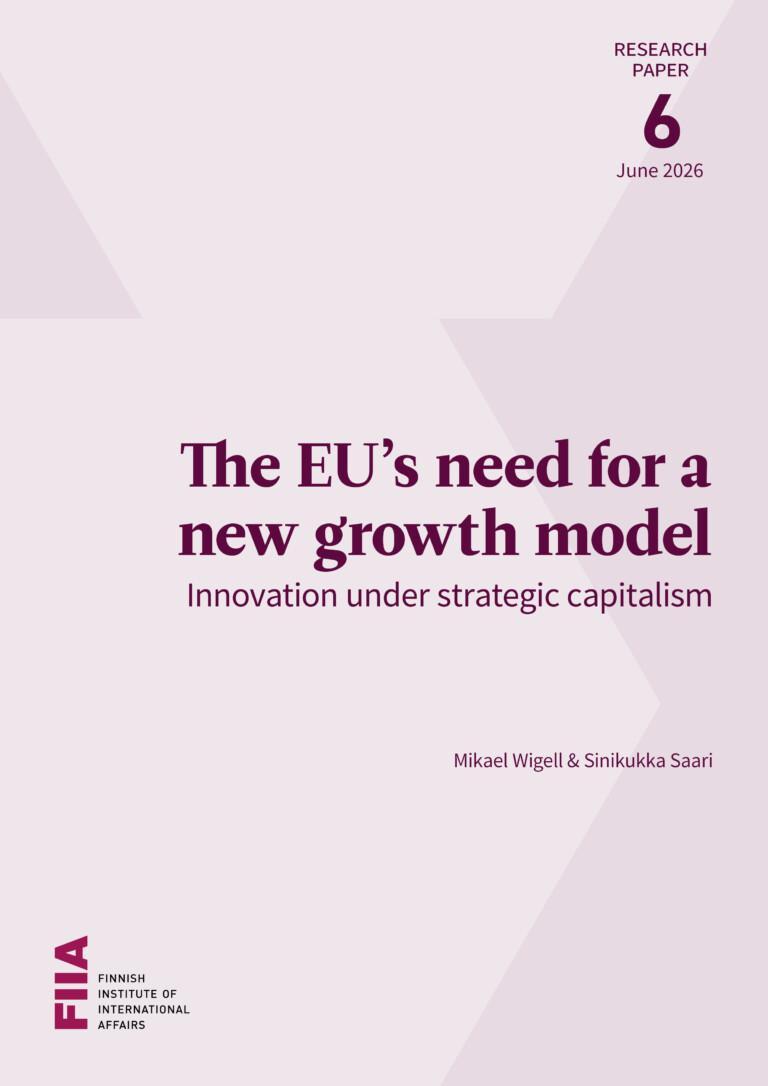
The EU’s need for a new growth model: Innovation under strategic capitalism

FIIA Briefing Paper
Lethal autonomous weapon systems: Regulatory momentum or global disconnect?