

23 September 2026
Russia’s 2026 Duma election exposed the Kremlin’s dilemma: it needs citizens to vote but fears political engagement. The exclusion of parties and candidates was not just about securing victory, but about preventing potential discontent from becoming too visible.
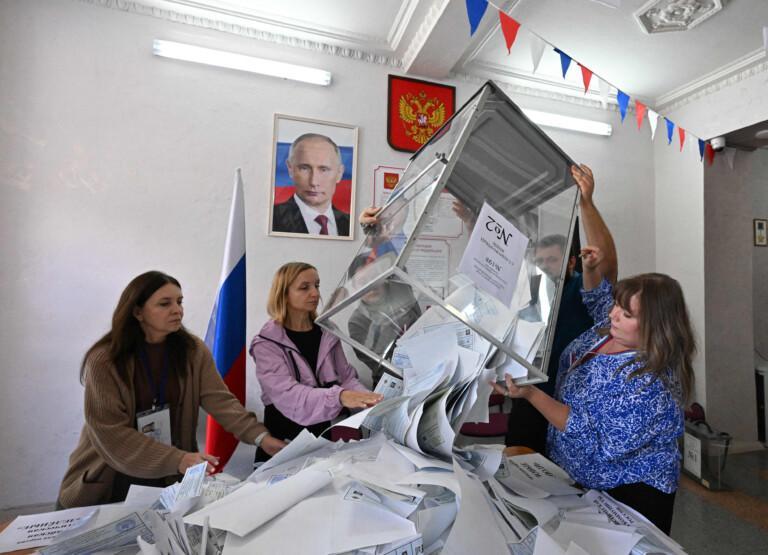
Russia’s 2026 State Duma election delivered the parliamentary outcome the Kremlin sought: United Russia, the party of power, won 57.9% of the party-list vote and approximately 350 of 450 seats, securing the party’s largest constitutional majority so far. Both the result and the official turnout of 59% were implausibly high compared to independent pre-election polls.
However, the election campaign revealed a central contradiction of Russia’s wartime authoritarianism. The regime needs citizens to participate in elections but increasingly fears the political engagement that election campaigns can generate. In 2026, it responded by closing the remaining channels through which fragmented dissatisfaction could become electorally visible.
The election was the first State Duma vote since Russia’s full-scale invasion of Ukraine. Compared with the previous election in 2021, the authorities had become more willing to exclude parties and candidates from the campaign altogether, and the electoral field narrowed dramatically. The number of party lists, candidates in single-member constituencies, and self-nominated candidates all fell substantially.
This was more than another turn of the screw on an already uncompetitive system. In 2021, despite extensive repression, the Communist Party of the Russian Federation (CPRF) could still function as a meaningful vehicle for protest voting. By 2026, candidates capable of developing an autonomous public profile or connecting fragmented grievances were seen as risks even when their parties remained loyal to the Kremlin.
The Kremlin’s fear that anti-war sentiment would become too visible led to the exclusion of Yabloko, the only openly anti-war party, from the federal ballot. The party was electorally marginal in 2021, but in 2026 it would have offered the only explicitly legal party-political vehicle for opposition to the war. Pollsters estimated that Yabloko could have won up to 24% support had it remained on the ballot. The party’s brief inclusion in the race attracted unexpectedly strong public interest, echoing the mobilisation around anti-war politician Boris Nadezhdin in 2024 and Alexey Navalnyi’s Smart Voting strategy in 2021. This suggests that even weak political actors can become vehicles for limited leaderless self-mobilisation.
The formal grounds of Yablokoʼs removal ranged from campaign financing rules to material published on restricted social-media platforms and alleged copyright infringements. The political significance of the decision lies less in the party’s electoral prospects than in the authorities’ unwillingness to let a measurable anti-war constituency coalesce around a recognisable electoral option. The Kremlin sought a smooth, predictable election. Yabloko demonstrated that even limited campaigning could spur unwelcome political mobilisation.
The subsequent exclusion of Nikolai Bondarenko, a prominent Communist politician and video blogger, showed that this logic extended to the systemic opposition as well. Bondarenko did not threaten the regime directly, but he possessed something increasingly problematic even for a formally acceptable opposition politician: an autonomous audience. His removal suggested that party loyalty alone no longer guaranteed protection when a candidate became capable of mobilising voters independently.
The cases of Yabloko and Bondarenko illustrate the distinguishing feature of the 2026 election: the Kremlin was managing not only electoral competition but political salience. Authoritarian stability depends partly on preventing citizens with similar grievances from recognising one another as a politically relevant constituency. The campaign therefore had to be visible enough to encourage turnout but sufficiently low-key to avoid building political momentum. Survey researchers reported remarkably low public awareness of the election only weeks before voting and interpreted this as deliberate – the authorities wanted participation without politicisation.
The treatment of war veterans exposed another contradiction. President Putin has repeatedly presented participants in the Ukraine war as a future “new elite”, and United Russia visibly incorporated veterans into the 2026 campaign. Yet the Kremlin had already retreated from reported plans to secure around 100 Duma seats for veterans, with sources indicating that controllability was prioritised over a heroic background. The campaign data underline the caution: veterans accounted for only around 4.5% of candidates, and many of those presented as veterans were already bureaucrats or politicians rather than political outsiders emerging directly from the battlefield. According to a preliminary estimate, around 50 veterans will enter the Duma.
This demonstrates that the Kremlin relied on the symbolism of a wartime elite without the risks associated with giving a platform to autonomous war heroes. Previous regional contests had already shown that military credentials alone were insufficient to translate into electoral popularity or active Kremlin backing. United Russia’s 2026 primaries therefore favoured candidates who combined military credentials with established political careers. As with the systemic opposition, loyalty was necessary but not sufficient; predictability and dependence mattered more.
The Kremlin thus obtained the Duma it wanted, but the campaign revealed why it considered increasingly elaborate control necessary. Russia’s political system is highly effective at suppressing organisations, restricting candidates and demobilising citizens but less capable of eliminating underlying dissatisfaction. The Yabloko and Bondarenko cases indicate that the authorities recognise that a politically passive electorate may still harbour significant discontent.
For European observers, the implication is that official election results should neither be treated as straightforward measures of popular support nor dismissed as meaningless theatre. The more informative indicators are what the regime chooses to suppress, which actors unexpectedly attract attention, and how much intervention is needed to keep citizens politically isolated from one another. The 2026 election demonstrated that the Kremlin’s objective is no longer merely to win elections. It is to make sure that voting does not become politics.
Photo: AFP / Lehtikuva