
24 November 2026
Europe must take greater responsibility for its own and Ukraine’s long-term security as Russian recklessness and coercion grow, and US support becomes less certain. Yet Washington’s readiness to strike a short-sighted bargain with Moscow risks compromising European security and undermining prospects for a lasting peace.
Since the Anchorage summit in August 2025, Moscow has sought to cultivate economic ties with Washington without making concessions on ending the war in Ukraine. Through Kirill Dmitriev, CEO of the Russian Direct Investment Fund, Russia has proposed various business ventures to the US negotiators, Steve Witkoff and Jared Kushner. Now these efforts appear to be bearing fruit, raising questions about potential personal gains for the US negotiators and the implications for European security.
At the same time, Moscow has sought to tie a settlement in Ukraine to a broader renegotiation of Europe’s post-Cold War security order. Russian President Vladimir Putin seeks a Cold War-style arrangement that recognises Russia’s great-power status and accepts its “sphere of privileged interests” in Eastern Europe. US President Donald Trump’s latest remarks suggest he is willing to put Europe’s security order on the negotiating table, as Moscow has long sought.
Wider deal as Russia’s bluff
The current situation presents Europe – a shorthand here for the EU, its member states, the UK and Norway – with a fundamental and multilayered strategic challenge. First, Trump’s policies increasingly undermine the joint Western strategy pursued since Russia’s full-scale invasion of Ukraine. This approach has combined three elements: financial and military support for Ukraine’s territorial defence; increased pressure on Moscow through economic sanctions and containment; and stronger European defence and deterrence. Together, these measures have sought to strengthen Ukraine’s position and bring Moscow to the negotiating table. Trump’s shifting approach weakens the credibility of European efforts to sustain this strategy.
Second, and more fundamentally, Europe can no longer rely on Washington’s commitment to the principles underpinning European security. Trump’s embrace of power politics appears closer to Russia’s spheres-of-influence thinking than to the idea of sovereign equality upheld by European actors. Existing commitments and institutional constraints may, to an extent, limit Trump’s room for manoeuvre, but his outlook opens the door to bargaining with Moscow over European security.
Third, Trump’s shifting priorities and demands for greater European defence contributions are pushing European states to assume more responsibility for Ukraine’s defence and the continent’s security. Yet Trump resists the greater European political agency this entails and is openly antagonistic towards the EU. This tension complicates transatlantic relations further.
Moscow has also recognised Europe’s growing role in continental security. As Dmitry Adamsky recently wrote in Foreign Affairs, Russian strategists increasingly see Europe as the principal obstacle to achieving Russia’s objectives in Ukraine. Traditionally, they have viewed Europe as little more than an instrument of US policy. Russia is now seeking to test Europe’s resolve and break its cohesion before the continent has fully come to terms with its new role, intensifying sabotage, political interference and military intimidation.
Moscow knows that Trump and his team cannot negotiate on Europe’s behalf or guarantee a lasting agreement. While Trump may believe a wider deal is in the works, Putin appears intent on using the prospect of it to divide the West and erode US support for Ukraine. In Putin’s calculation, victory in Ukraine would put Russia in a stronger position to reshape the European security order. Europe’s first priority, then, must be to step up its support for Ukraine.
Europe needs to show greater resolve and accept risks
To meet these formidable challenges from both east and west, Europe must act with greater resolve and cohesion. First, Russia’s systematic and increasingly coercive subversion against European societies must elicit a stronger collective response. Support for targeted member states and coordinated asymmetric countermeasures should become standard EU practice, as European Commission President Ursula von der Leyen envisaged in her State of the Union address in September. The forthcoming European Security Strategy should turn the proposed Emergency Security Protocol into an effective mechanism for rapid consultation, assistance and collective action. Russia’s coercive hybrid operations must be treated as a sustained campaign against Europe as a whole.
Second, Europe must translate its growing responsibility for continental security into greater influence over efforts to settle the war in Ukraine. This requires a willingness to engage strategically with both Washington and Moscow, however frustrating or daunting the task. Europe should strengthen its negotiating position by stepping up its support for Ukraine and deepening ties with Kyiv.
The late October phone call with Putin by Finnish President Alexander Stubb and Norwegian Prime Minister Jonas Gahr Støre illustrates both the desire to strengthen Europe’s role and the difficulties of doing so in practice. Although their substantive positions are widely shared among other European leaders, the initiative was insufficiently coordinated. However, the vocal criticism that followed also showed poor strategic judgement. Public quarrels over who speaks for Europe weaken its diplomatic weight precisely when it needs to act swiftly and with common purpose. The E5 + EU format that has emerged since then is a step forward, even if it is somewhat unwieldy.
To gain leverage over both Washington and Moscow, European leaders must agree on what they seek, what they can offer, and where they will hold firm. They should call Moscow’s bluff over its supposedly constructive proposals for a wider security agreement and bargain more actively with Washington. Greater diplomatic initiative carries risks, and Europe must be prepared to accept them. To echo Winston Churchill, half-measures and hesitation disguised as caution may ultimately prove more dangerous.
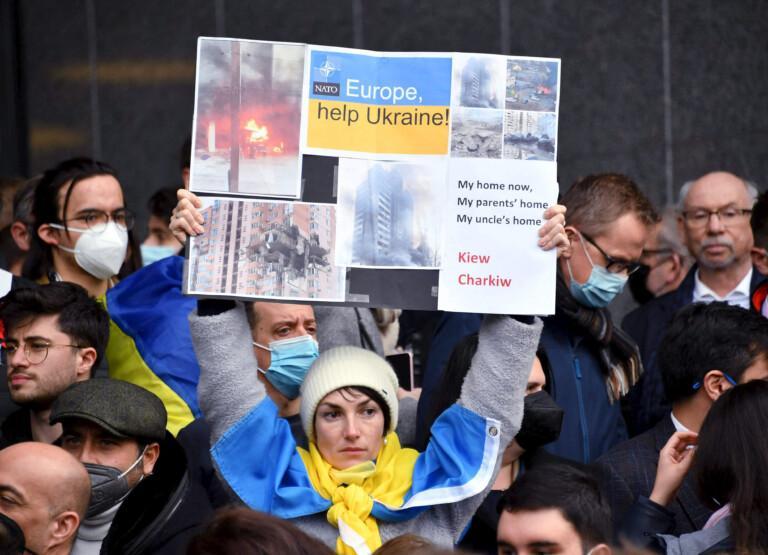
Photo: John Thys / AFP / Lehtikuva