
6 November 2026
The Democrats won a decisive victory in the 2026 US midterm elections, taking control of both chambers of Congress. But as both Democrats and Republicans struggle to deliver the change their voters demand, growing disillusionment may pose a serious threat to American democracy.
On Election Day in 2026, American democracy survived to fight another day. Despite fears that the Trump administration would interfere with the election, voting proceeded smoothly across the country. Despite President Trump’s campaign to sow distrust in elections, voters turned out in substantial numbers. And despite repeated attempts by Trump and his Republican Party to tilt the playing field in their favor, voters proved in no uncertain terms that it is still possible in the present-day United States for dissatisfied citizens to replace those in power through free and fair elections.
The Democratic Party won a decisive victory that left little room for contestation. Contrary to the expectations of his opponents, President Trump publicly accepted the results, disincentivizing his fellow partisans from questioning their losses.
However, the biggest threat looming over American democracy was perhaps never a dramatic coup in the style of the January 6, 2021 insurrection but a slow erosion of democratic legitimacy in the eyes of ordinary Americans.
In Pew Research polls, Americans’ trust in the federal government has been consistently below 30% ever since the 2008 financial crisis. The numbers look even worse for Congress, with trust in the institution hovering between 7% and 17%.
Election after election, American voters signal their desire for change. Yet time and time again, they are disappointed. Power changes hands, but life does not seem to get better.
Perhaps this is why, in the latest World Values Survey, 37% of Americans liked the idea of a strong leader unbothered by elections.
The cost of living remains a major problem
In polls, the economy has consistently been one of the most important issues for voters. This is not surprising, given the lived experience of most Americans. Data collected by the analytics platform PYMNTS paint a dire picture of Americans’ ability to save for emergencies or even handle day-to-day expenses.
Throughout the 2020s, the percentage of Americans living from paycheck to paycheck has consistently been above 50% and often over 60%. In the fall of both 2024 and 2026, two-thirds of Americans were living in this situation. Around one-fifth to one-fourth of Americans struggle to pay their bills.
For many voters, concern over their personal finances was an important reason to vote for Trump in 2024. The biggest single reason for the Republicans’ excruciating 2026 midterm loss was most likely Trump’s failure to alleviate that concern, coupled with his actions that created additional economic worries, particularly his tariff policies and the war in Iran.
Now it seems likely that yet another disappointment awaits voters struggling to make ends meet.
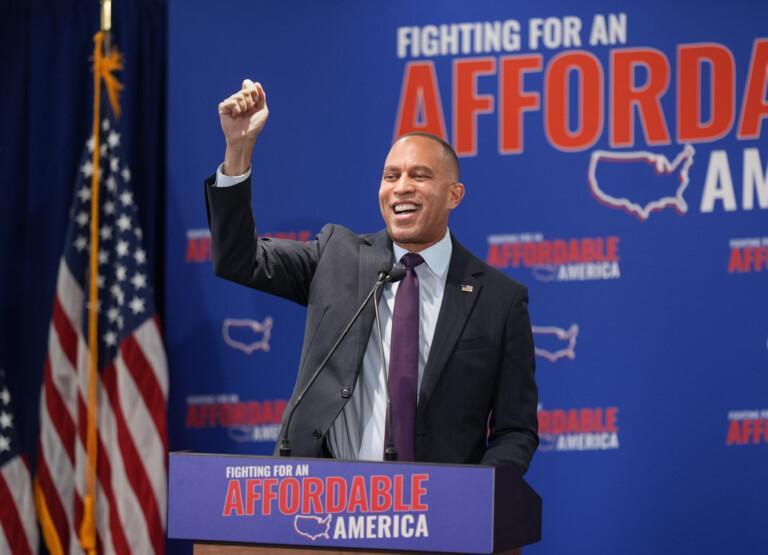
In their 2026 campaign, Democrats highlighted affordability, but with Trump still in the White House with veto power, it will be difficult, if not impossible, for them to bring about meaningful change in the cost of living.
As the 2028 presidential election approaches, voters will most likely still be dissatisfied with their personal finances. If that is the case, control of Congress may become a liability for the Democrats. From a position of power, it will be far more difficult for them to convincingly portray themselves as the affordability party.
MAGA voters face further disappointment
For the Republicans, the midterm results raise big questions about the future direction of the party. Despite Trump’s ability to resist attempts to sideline him in the past, the stinging defeat, combined with his ineligibility for another presidential run, will inevitably loosen his grip on the party.
However, there is no reason to equate the approaching end of Trump’s political career with the downfall of the MAGA movement. Trump created the movement by appealing to voters dissatisfied with growing pluralism, voters who felt unseen and ignored while Americans with different minority identities were gaining more social and political power. These MAGA voters remain a force to be reckoned with – and they, too, have reason to be disappointed.
For voters who believe America was great back when white, Christian, heterosexual men were the only ones with political power, Trump has failed to make America great again. As a result of these midterms alone, the United States will for the first time have a Muslim senator, a female Native American senator, an openly gay male senator, likely its first Black speaker of the House, a Black female governor and a female Native American governor.
For a Republican 2028 hopeful, rejecting MAGA voters is a nonstarter. Instead, the key to securing the nomination may prove to be the successful channeling of the fear and dissatisfaction caused by these historic firsts and other advances by members of underrepresented groups seeking a voice in society. In addition, MAGA voters are not immune to financial worries, and hence the candidate needs to convince both the MAGA camp and voters more broadly of their economic credentials.
A MAGA 2.0 may already be in the making. However, its ability to deliver on its promise of restoring the America its voters long for is even more questionable than the ability of either party to address the affordability crisis.
The more dissatisfied voters become with both parties, the easier it may become for a would-be autocrat to convince them to rethink their political ideals.
Even though around a third of Americans named the state of democracy as their top issue in exit polls, it would be a mistake to read the midterm result as a wholesale rejection of strongman rule. Elsewhere in the world, voters have been willing to tolerate or even happy to support autocratic rule that has delivered economic benefits.
It seems safe to assume that some voters cast their ballots in protest against Trump’s actions that have eroded American democracy, such as aggrandizing his power at the expense of Congress and the judiciary. However, for others, Trump’s biggest failure was probably not his attempt to become an all-powerful ruler, but rather his failure to use the power he has accumulated to make America affordable again.
Photo: J. Scott Applewhite / AP / Lehtikuva